

Lindsie McBratney and Stephanie Fairbanks turned in a commanding performance Sunday in the Women’s 3.50–3.99 Doubles division, posting an 11–8 victory over Caroline Wong and Teresita Alvarez. The win came in straight games, with the winning duo sealing the match in a single decisive frame that showcased their edge in consistency and court coverage.
The match, recorded on September 20, 2026, pitted two pairs with contrasting pre-match ratings against each other. McBratney and Fairbanks entered with ratings of 3.138 and 3.016 respectively, while Wong (3.782) and Alvarez (3.393) arrived with slightly higher individual marks. Yet rating snapshots don’t tell the whole story — and on this afternoon, the lower-rated pair executed with the kind of synergy that separates contenders from also-rans.
Kitchen Control and the Art of the Dink
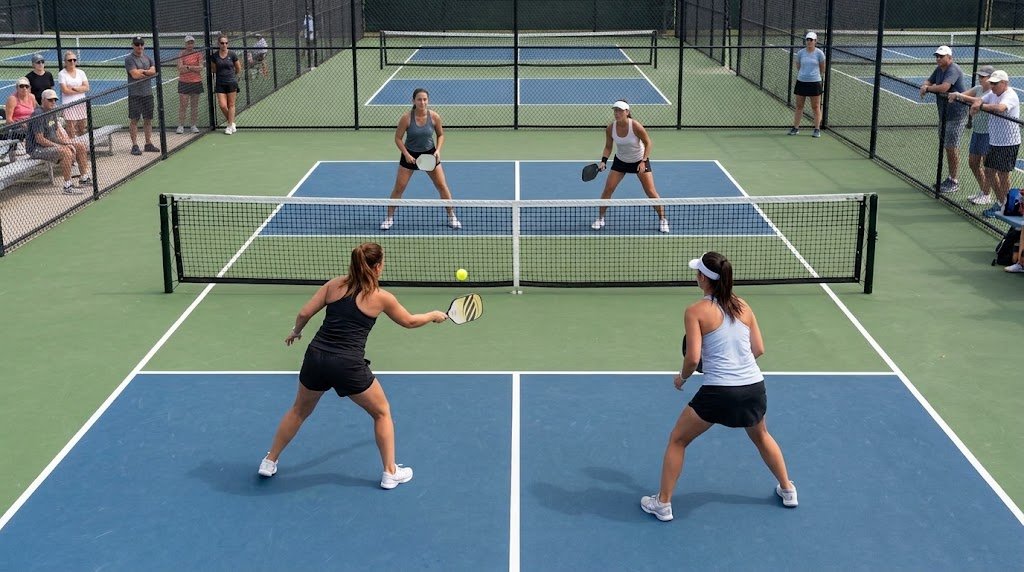
In pickleball, the kitchen — that non-volley zone stretching seven feet from each side of the net — is where rallies are won or lost. Controlling the non-volley line means occupying the space just behind it, where you can answer a dink with another soft, placement-driven shot without ever needing to volley. This position lets you dictate pace, force errors, and keep your opponent guessing.
Volleying inside the kitchen, however, is illegal. Once a ball lands in that zone, you must let it bounce before striking it — any attempt to hit it out of the air results in a fault. The distinction matters: staying behind the line keeps you legal; creeping forward into the no-volley zone without letting the ball bounce invites trouble. Smart players use dinks — those gentle, low-arcing shots designed to land just over the net and deep in the opponent’s kitchen — to draw their adversaries into uncomfortable positions, forcing them to either let the ball bounce (giving up the offensive initiative) or risk a fault.
Faults, Out-of-Bounds, and the Margin of Error
Every shot carries risk. A ball landing long or wide is out-of-bounds; a foot fault on serve, a volley from within the kitchen, or a double-bounce before return all constitute faults. In a match as tight as 11–8, even one unforced error can shift momentum. While no specific faults or out-of-bounds calls were recorded in this contest, the margin suggests that McBratney and Fairbanks minimized their mistakes while capitalizing on their opponents’.
The 11–8 scoreline reflects not just points won, but pressure absorbed. In doubles, chemistry often trumps individual talent. McBratney and Fairbanks appeared to communicate seamlessly, rotating smoothly to cover gaps in their opponents’ defense. Their ability to sustain pressure across the frame — without faltering in the stretch — proved decisive.
What the Score Says
An 11–8 win isn’t a blowout, but it’s a statement. It’s the kind of result that whispers confidence rather than shouts dominance. Wong and Alvarez, despite their higher pre-match ratings, couldn’t find the rhythm needed to counter the steady, methodical play of their counterparts. The game contributed a single, complete narrative: no comebacks, no dramatic tiebreaks — just a clean, efficient victory that rewarded preparation and poise.
For McBratney and Fairbanks, this win is a data point, not a destination. Ratings may shift in the coming weeks, but this performance will linger in the memory of anyone who watched them hold their nerve under the bright lights of competitive doubles. In pickleball, as in life, sometimes the quietest wins are the most telling.