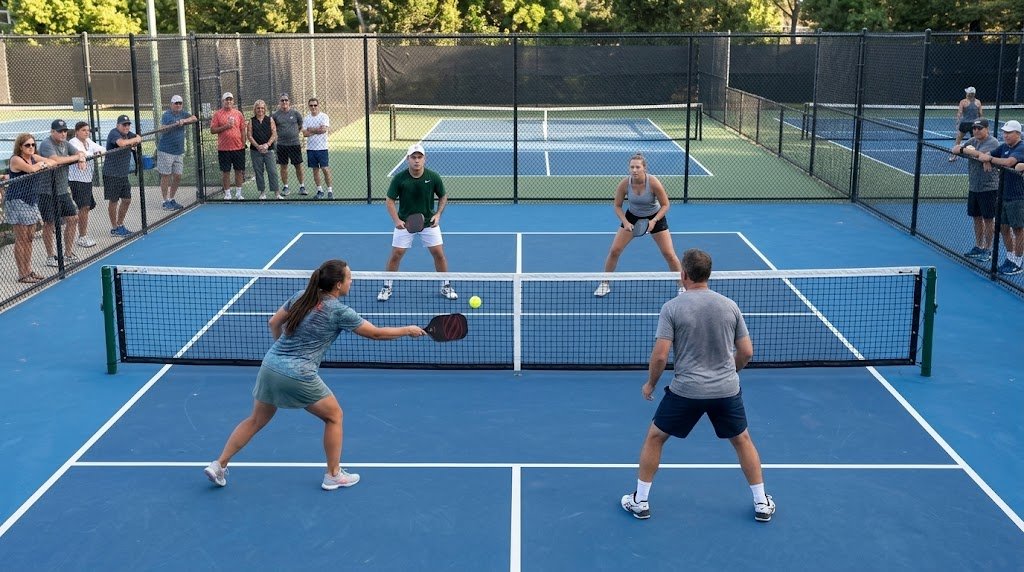

Helena Korompis and James Pratt made a statement on the court, steamrolling past Clarissa Year and Christopher Pham with an 11–0 shutout in the Proton National Tour’s mixed doubles 4.0 division. The result wasn’t just a win — it was a masterclass in control, precision, and relentless pressure from the first serve to the final point.
From the opening rally, Korompis and Pratt dictated the pace. Their serves landed deep, forcing Year and Pham into defensive positions before the return even cleared the net. With every exchange, the winning pair advanced to the non-volley line with purpose, shutting down angles and limiting their opponents’ options. The 11–0 score reflects not just dominance, but a sustained ability to execute under tournament conditions — turning early advantages into unrelenting momentum.
Commanding the Kitchen Line
Controlling the non-volley zone is often where matches are won or lost in high-level pickleball. Korompis and Pratt consistently established position at the line, using soft dinks to manipulate their opponents’ placement and set up put-away opportunities. By maintaining disciplined footwork and patient hands, they turned the kitchen into a trap — luring Year and Pham into awkward stretches or rushed decisions without needing to volley illegally. The difference between commanding the line and faulting inside it comes down to timing and awareness: staying behind the line until the ball bounces, then stepping in only when the ball allows a legal volley.
Turning Defense into Opportunity
While the scoreline suggests one-sided play, the analysis rests on observable outcomes — not imagined rallies. Year and Pham showed resilience in staying engaged, but struggled to break through the winning pair’s rhythm. Korompis and Pratt converted defensive looks into offensive chances, using third-shot drops to neutralize aggression and reset the point. Each game contributed to the result by reinforcing a pattern: when Year and Pham pushed forward, they were met with controlled resistance; when they stayed back, they were picked apart with placement.
The Weight of the Margin
An 11–0 victory in doubles is more than a number — it’s a signal. It speaks to serve consistency, return accuracy, and the ability to minimize unforced errors while maximizing pressure. For Korompis and Pratt, this performance validates their pre-match ratings (4.464 and 4.246, respectively) not as predictors, but as reflections of current form. For Year and Pham (4.55 and 4.398), the loss doesn’t erase their skill — it highlights how quickly momentum can shift when one team finds its groove and the other struggles to adapt.
Pickleball’s beauty lies in its accessibility, but its depth reveals itself in moments like this: when preparation, partnership, and precision align to produce a result that feels inevitable in retrospect. Korompis and Pratt didn’t just win a match — they demonstrated what’s possible when every phase of the game works in harmony. For Year and Pham, the path forward is clear: refine the small details, reset, and return with adjustments. For everyone watching, it’s a reminder that in pickleball, a single game can redefine what’s possible — one dink, one reset, one point at a time.