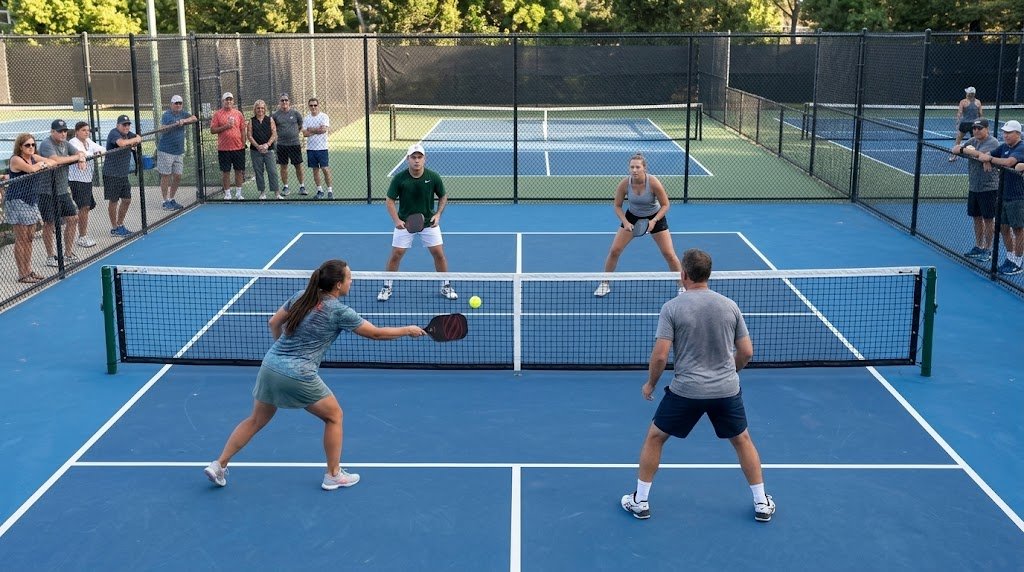

Helena Korompis and James Pratt made the clearest statement on the available scoreboard at the $30,000 Proton National Tour by MPO - Cash Prize Tournament in Corona - Mixed Doubles 4.0 on Sept. 20, 2026.
The pairing beat Clarissa Year and Christopher Pham 15–8, a straight-game win by seven points. The single recorded game supplied the complete result: no second game was needed for either side to finish the contest.
A Clean 15–8 Sweep
The scoreline carried the shape of a commanding performance rather than a dead-even tussle. Korompis-Pratt finished nearly twice as many points as Year-Pham, while the seven-point cushion showed that the winners had room without the contest being scoreless at the other end.
Pre-match ratings put the teams in a tight band. Korompis carried a 4.748 rating and Year was at 4.537, a difference of 0.211. Pratt was listed at 4.324 and Pham at 4.349, with Pham holding the narrower 0.025 edge. Those figures are snapshots of the players before this match, not current ratings and not a promise of what comes next. They also did not prevent the winning pair from building the larger margin.
The result was recorded in the event listing and gives Korompis-Pratt the win. Year-Pham still produced eight points, so the scoreboard was not empty, but the winners controlled the final arithmetic from start to finish.
What the Kitchen Can Change
Pickleball often turns on inches at the non-volley line. A team that settles there can shorten the court for opponents, meet soft shots earlier and make the next ball harder to attack. That positional control is not the same as an illegal kitchen play.
The non-volley zone extends seven feet from the net. A player may stand at the line and volley only when neither the player nor anything worn or carried touches the zone. Stepping inside the kitchen to hit a volley, or carrying momentum into it after a volley, is a fault. Players may enter the zone to play a ball after it bounces.
Dinks are the soft exchanges that often set up that line position. A well-placed dink can pull an opponent forward, create a higher reply or buy time to move up together. A dink that floats too high can invite a put-away, while one that finds the net or lands long simply gives the point away. Those are general possibilities; the source does not record individual rallies or faults from this match, so they should not be assigned to Korompis, Pratt, Year or Pham.
Out-of-bounds risk is another part of the same calculation. A harder shot may pressure an opponent, but it also increases the chance of missing long or wide. A softer shot can stay safer, yet leave an attacking opportunity if it sits up. Good teams weigh those choices point by point rather than treating power or patience as automatic answers.
One Game, One Clear Story
The only recorded game made every point count toward the final 15–8 ledger. Korompis-Pratt supplied the 15 that carried the win; Year-Pham supplied the eight that kept the game from being a blank. There was no additional game to extend, reverse or qualify that outcome.
For the winners, the result showed how a paired effort can turn a modest ratings spread into a decisive finish. For Year-Pham, the eight points were meaningful resistance even though they could not catch the leaders. The match ended with Korompis-Pratt ahead by seven, a clean straight-game statement built on the one game that was recorded.