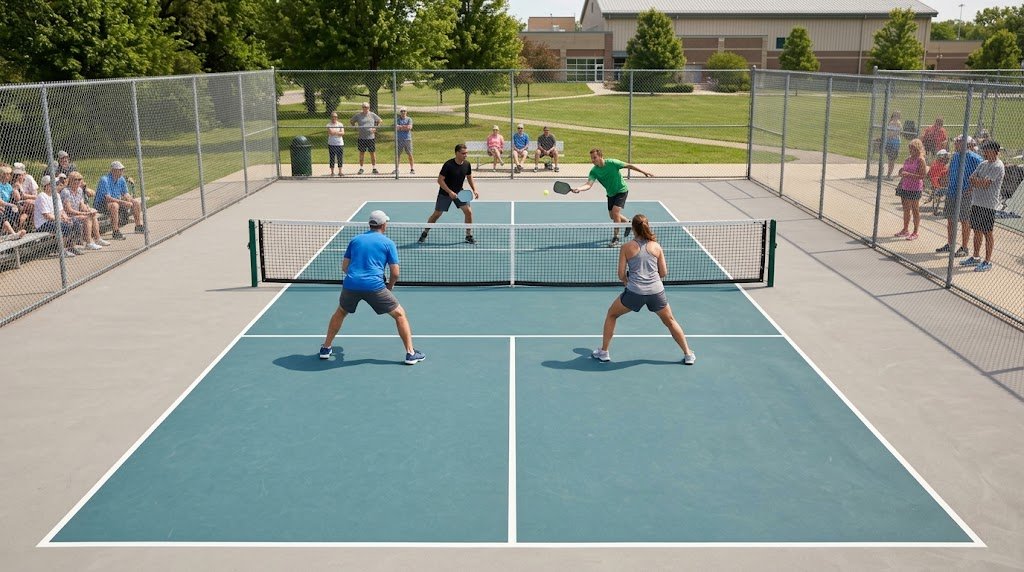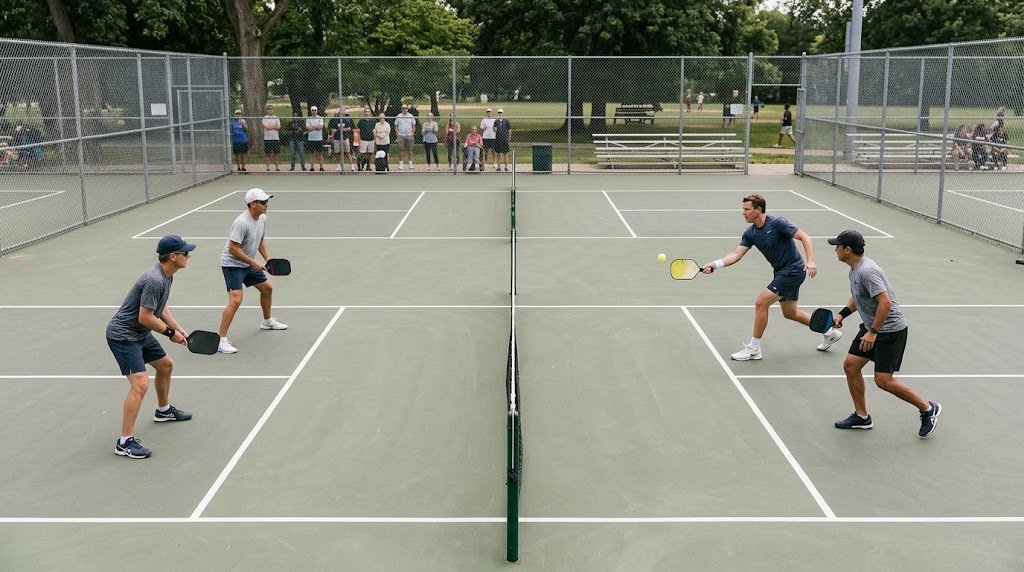
Elizabeth Herren and Ivan Ruiz did not need a second game to make their mixed-doubles point. The pair won 15–8 over Tram Huynh and Coel Kawaguchi, an emphatic straight-games result in the Mixed Doubles 4.0 draw at the $30,000 Proton National Tour by MPO - Cash Prize Tournament in Corona.
The seven-point margin is the headline: a 15–8 win is a commanding statement, not a photo finish. The recorded result also carries an intriguing ratings backdrop. Ruiz arrived with the highest pre-match rating at 4.778, followed by Huynh at 4.564, Kawaguchi at 4.469 and Herren at 4.188. Those figures are a snapshot of the field, not a prediction of what happens next.
Herren and Ruiz Set the Pace
Herren and Ruiz took the only game on the card, 15–8, and that was enough to seal the match. The winners combined the highest individual rating on the winning side with a partner whose 4.188 pre-match rating shows that the pairing was not simply a story of one standout carrying the load.
Huynh and Kawaguchi stayed in the contest long enough to keep the scoreboard honest, but they could not pull level or force a deciding game. Their pairing had the stronger combined pre-match snapshot, 9.033 to the winners’ 8.966, yet the result turned on the one game that counted. In doubles, a small edge in timing, patience and shot selection can stretch quickly when a team starts dictating the rhythm.
The 15–8 score says plenty on its own. It was not a squeaker, and it was not a rally-by-rally thriller. It was a controlled, seven-point win built around a team that found the cleaner path through the game and kept its opponents chasing the next point.
What the Kitchen Really Means
The non-volley line is one of pickleball’s most important pieces of real estate. A team that controls the kitchen area is not necessarily smashing every ball; often, it is simply denying easy attacking angles while staying ready to react. Good positioning lets players meet soft shots earlier, cover the middle and make the opposition decide whether to lift the ball or keep trading dinks.
That is different from an illegal kitchen volley. A player may not volley while standing inside the non-volley zone or touching it, and the rules also account for momentum after a volley. A player can enter the kitchen to play a ball that has bounced, then leave again, but a volley requires the proper position and timing. The distinction matters: controlling the line is strategy, while crossing into the zone for an illegal volley is a fault.
Dinks are the quiet currency of that battle. A well-placed soft shot can pull an opponent forward, open a gap or invite a pop-up, but a dink that sits too high can hand over the initiative. The risk is not just the shot itself; it is what happens when a team gets pinned behind the baseline or forced into a rushed reset.
Faults and out-of-bounds calls add another layer. A serve or return that lands long, a shot that misses the court, or a non-volley-zone violation can erase a promising point in an instant. Players have to balance aggression with accuracy, especially when a deep drive offers power but also increases the chance of sending the ball wide or long. The best teams know when to press and when to reset the point.
Those are general pickleball principles, not a reconstruction of this match. The source records the final score but does not list individual rallies, faults, dinks or kitchen violations, so the specifics of how Herren, Ruiz, Huynh and Kawaguchi won or lost each point remain unreported.
The Result in Context
For Herren and Ruiz, the value of the win is its clarity. They converted a competitive mixed-doubles assignment into a straight-games victory, with Ruiz’s 4.778 pre-match rating providing the strongest numerical marker in the matchup and Herren adding the complementary piece.
For Huynh and Kawaguchi, the loss does not erase the quality suggested by their combined 9.033 pre-match snapshot. It simply means that, on this occasion, the seven-point gap was the difference between staying even and watching the match slip away.
The final score, 15–8, leaves no ambiguity about the day’s hierarchy. Herren and Ruiz supplied the sharper finish, while Huynh and Kawaguchi were left to reflect on a game that never quite turned. In a sport where inches at the kitchen line and one careful reset can change everything, this was the cleanest possible message: the winning pair controlled the scoreboard, and the scoreboard told the story.