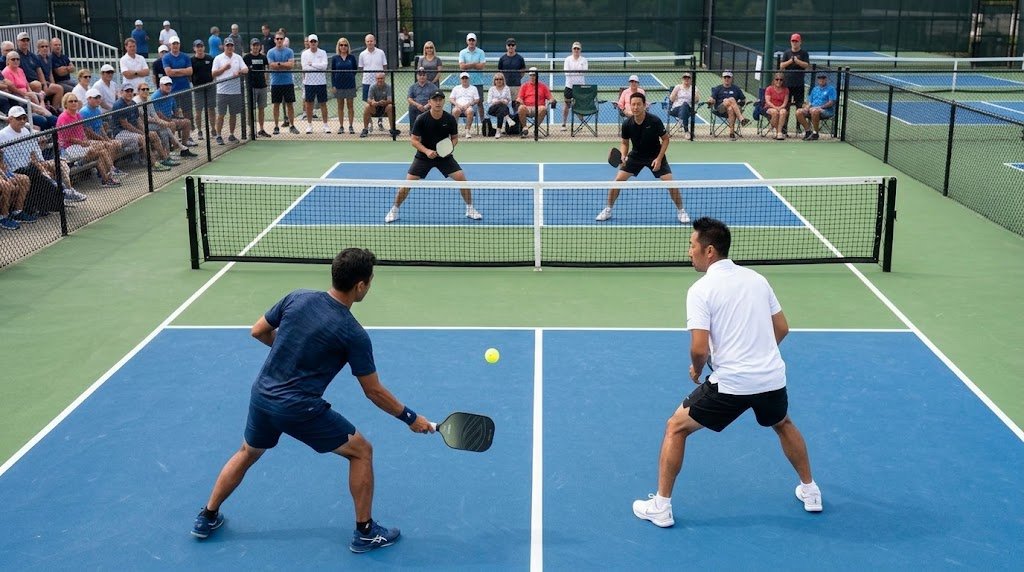


Liem Nguyen and Peter Lam supplied the sharpest headline of the day in Men's 3.0 - 3.49 Doubles, opening with an 11–2 win over Trevor Tecson and Ryan Kim. The nine-point margin made it a commanding straight-games result rather than a tight finish, and the recorded match data lists Nguyen and Lam as the winners.
The pre-match ratings add useful context, though they are only a snapshot. Nguyen arrived at 2.848 and Lam at 3.546. No pre-match ratings were supplied for Tecson or Kim, so the score should not be read as a verdict on their ratings or as a prediction of future movement.
A clean opening
Nguyen and Lam converted their opening opportunity decisively. An 11–2 game requires a team to stay ahead across the board, and the margin leaves no ambiguity about the result. The winning side controlled the outcome from the start, while the losing pair faced a steep climb after the early gap.
That is what makes this result feel like a statement. It was not a late escape or a final-point drama; it was a clean, efficient performance built around a dominant first game. In a format where momentum can swing quickly, Nguyen and Lam kept the scoreboard moving in their direction.
Kitchen control, without the kitchen crime
A useful way to understand that kind of scoreboard pressure is through court position. In doubles, controlling the non-volley line often means holding the kitchen line, keeping the ball low and making the opponents lift or reach. It is a positioning advantage, not a license to step into the non-volley zone and volley.
The distinction matters. A player may stand near the non-volley line and volley a ball that has bounced on the opponent’s side, provided the player does not touch the kitchen or its line during the volley motion. Entering the kitchen to play a ball after it bounces is legal, but volleying from inside the kitchen is a fault. The supplied record does not identify any rally or fault involving these four players, so those are general rules rather than claims about this match.
Dinks can help a team maintain that advantageous position. Soft, well-placed shots may draw a weak return or force an opponent to hit upward, creating a better chance for the next shot. They can also go long or into the net, which is why patience and placement matter more than simply tapping the ball back. Out-of-bounds risk rises when a team tries to add pace or angle without enough margin for error. A deep shot can be effective, but an overhit attempt gives the point away; a conservative shot that sits up can be just as dangerous if it invites an attack.
Those principles explain why a team can look composed without needing a dramatic rally to prove it. Good kitchen positioning reduces the number of difficult choices, while poor positioning can turn an ordinary exchange into a scramble. The lesson is general: protect the non-volley line, choose the shot that keeps the ball in play, and make the opponent solve the next problem.
What the game contributed
The single game supplied in the record was decisive. It established the winner, produced the full nine-point margin and completed the match outcome. There is no second game to compare, no extended series to analyze and no basis for describing the result as a comeback or a thriller.
Instead, the story is straightforward and still satisfying: Nguyen and Lam took control, converted the opportunity and finished 11–2. Tecson and Kim were on the wrong side of a lopsided score, but the record does not support any claim about how individual rallies unfolded.
For the winners, the result offers a clean marker of effectiveness in this doubles matchup. For the challengers, it provides a clear scoreboard reference point without turning one match into a verdict on ability. In pickleball, a result this emphatic is best understood as a day when one team’s execution and positioning translated directly into points.
The final perspective is simple. Nguyen and Lam did not need a fifth-game twist or a photo finish to make an impression. They delivered a crisp straight-games win, and the 11–2 line stands as the match’s loudest piece of evidence.