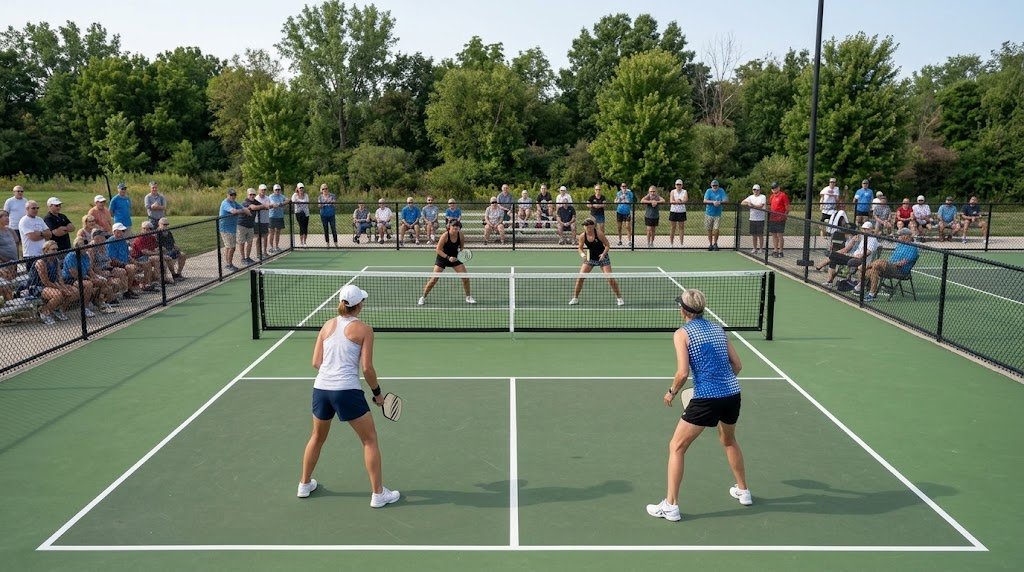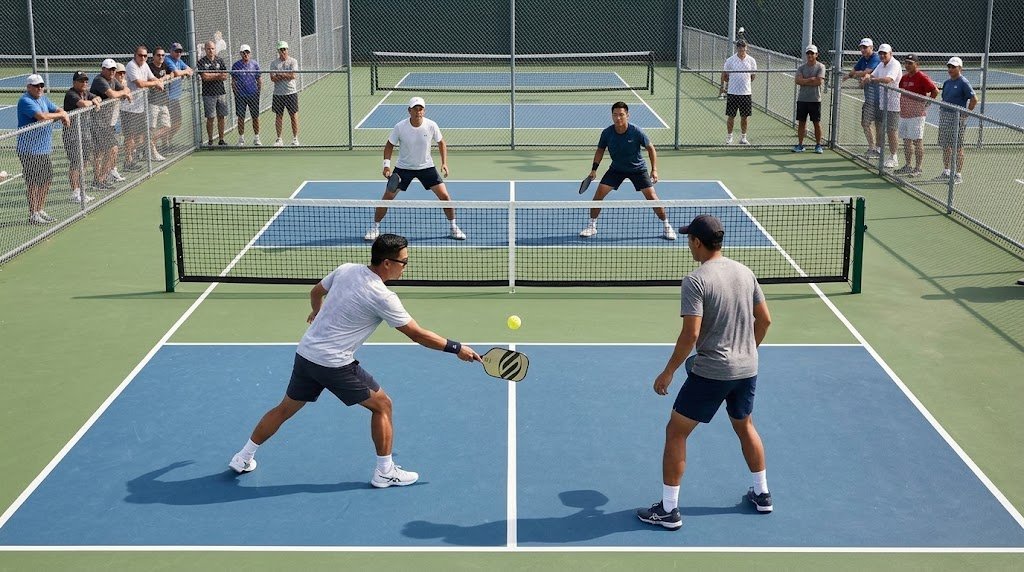

A clean 11–0 on the scoreboard is enough to raise eyebrows. Bryant Chang and Don Huynh did not need a last-pace rally or a miracle-angle finish to make Men’s 4.0-4.49 Doubles feel like a straight-games statement. The recorded result gave them an exact 11–0 victory over Tim Nguyen and Dan Bui on September 20, 2026.
That margin carries two meanings. It is a scoreboard shutout, not evidence that the other side never touched a ball. It is also a dominant performance in the only match recorded here. There are no additional games to compare, so the straight-games result stands as the full account.
The teams entered with very different pre-match rating snapshots. Nguyen, at 3.523, faced a 4.287-rated Bui, giving their team a combined 7.810. Chang and Huynh combined 3.099 and 4.047 for 7.146, a difference of 0.664 in favor of Nguyen and Bui. Those numbers describe a starting point, not current ratings or a forecast of what either team might become.
The Math of a 11–0 Result
An 11–0 score is not a nail-biter wearing a whistle. It is commanding, and it does not require inventing drama that the record does not show. The margin is 11 points, with the winning side recording zero in the recorded game.
The two teams’ pre-match averages were 3.905 and 3.573, respectively. Those figures help frame the matchup without pretending they measured this particular game. A pre-match snapshot can describe a moment before competition; it cannot narrate the points that followed.
In doubles, a shutout is also a reminder that the scoreboard reflects a completed game, not the number of exchanges. It does not mean 11 rallies occurred, and it does not explain how each point was won.
Kitchen Control Is Not Kitchen Illegal
For players studying this result, the kitchen deserves special attention because it is where many games are quietly decided. The non-volley line is the boundary at the net. A player may stand on or near it to control space, especially when a dink leaves an opponent with a limited reply. Taking position there can shorten angles and force the other team to work.
That is different from volleying inside the kitchen. A volley is struck before the ball bounces, and the kitchen rule prohibits a player from volleying while standing inside that zone. Merely occupying the kitchen is legal; the illegal situation comes from taking a volley there. The recorded result does not identify any rally, fault, or rule situation, so this is general analysis rather than a claim about what Chang, Huynh, Nguyen, or Bui did.
The dink game offers a useful test of that distinction. A soft, controlled dink can pull an opponent forward and create an opening without asking for a smash. But a dink that sails long or wide becomes an out-of-bounds fault, and a shot struck before its bounce while the player is in the kitchen can create a different fault. Players who approach the line need to know when to reset, when to let the ball drop, and when a controlled volley from outside the kitchen is the safer option.
Out-of-bounds risk matters beyond the kitchen. A ball that lands outside the court is out; a ball that clips the line is in. The danger is not merely hitting too hard. A dink can drift, a drive can sail, and a player chasing a wide ball may leave the court behind. Keeping the paddle face steady and choosing a shot with room to spare is often more useful than chasing a perfect winner.
Straight Games, Clear Perspective
Because this was a doubles match, both partners share the result: Chang and Huynh earned the 11–0 victory, while Nguyen and Bui were on the losing side. The pre-match ratings do not erase that outcome, and the outcome does not rewrite those ratings. The most accurate reading is simple: Chang and Huynh produced the recorded shutout, and Nguyen and Bui were held to zero in the only game available for comparison.
That is a satisfying ending for a scoreboard that speaks clearly. Pickleball may be playful, but an 11–0 result is not a joke at anyone’s expense. It is a commanding performance, a reminder that control and clean execution can turn a doubles matchup into a statement, and a useful prompt for the next game: own the kitchen, respect the line, and keep every shot inside the court.