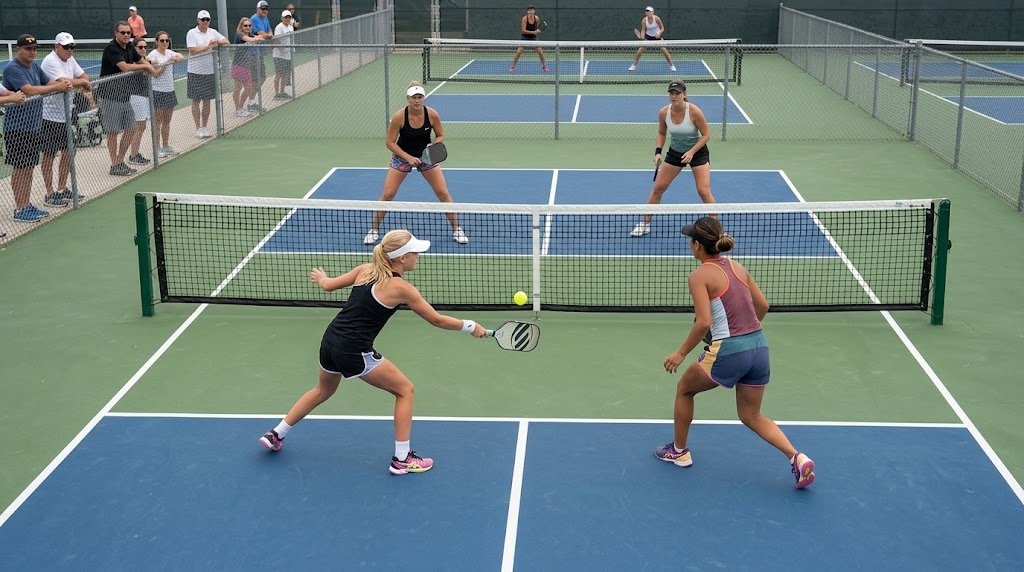

Rising Heat at the Net
Nikki Choi and Rebecca Tan stood tall in Women's 4.0-4.49 Doubles, taking the game 13-11 over Kara Tran and Amy Li. The result, recorded on September 20, 2026, delivered a tightly contested first set that refused to settle early. Both teams came out trading pace, and the scoreboard told the story of a match that stayed alive deep into the opening game.
With pre-match ratings of 3.837 for Choi and 3.82 for Tan against Tran at 3.584 and Li at 4.007, the lineup carried a fascinating blend of projected strengths. Those figures are a historical snapshot from before this match and carry no weight as current standings or forecasts. Still, they framed a fascinating clash: Li's high individual rating paired against the steadily balanced duo of Choi and Tan. On the day, the pair of Choi and Tan converted that balance into a narrow but decisive edge.
What the Scoreboard Actually Said
The single recorded game ended 13-11, a slim margin that reflects real pressure on both sides rather than a runaway. A two-point gap at this level can feel enormous, and every sequence clearly mattered. Tran and Li pushed hard to stay within striking distance, but Choi and Tan held their nerve when the score tightened. There were no additional games listed, so this one result carried the full weight of the reported encounter.
It is important not to overread a one-game lineup. The event format confirmed doubles play, and the recorded outcome reflects only what officially stands. Neither side's effort is diminished by the narrow spread; instead, the match underlines how finely matched these competitors are within the division.
What General Doubles Play Looks Like at This Level
Since no rally details, faults or line calls are recorded here, the analysis stays broad. In women's doubles at this rating range, kitchen positioning often separates good teams from sharp ones. Controlling the non-volley line means staying ready near the front while respecting the zone where volleys are not allowed. Volleying illegally inside the kitchen, often called a fault, is a separate concept from simply standing close and preparing. The distinction matters: occupying that space is legal, but striking the ball while fully inside it is not. No specific violation is implied here.
Dinking adds another layer. A well-placed dink can drag an opponent forward and soften their attack, while an out-of-bounds risk remains a constant threat on any high float. Teams must judge trajectory carefully, especially when pressure pushes the ball higher than planned. None of this is claimed as something any named player did during this match, only what generally shapes competitive doubles.
A Satisfying Result for the Division
Choi and Tan leave this result with a clear statement: composure under pressure can outweigh individual rating snapshots. Tran and Li showed the resilience to keep the game within reach, and their effort deserves full respect. At 13-11, every point felt earned, and the final order reflects a contest that stayed fiercely open until the end. For a division built on teamwork and timing, that is exactly the kind of match worth watching.