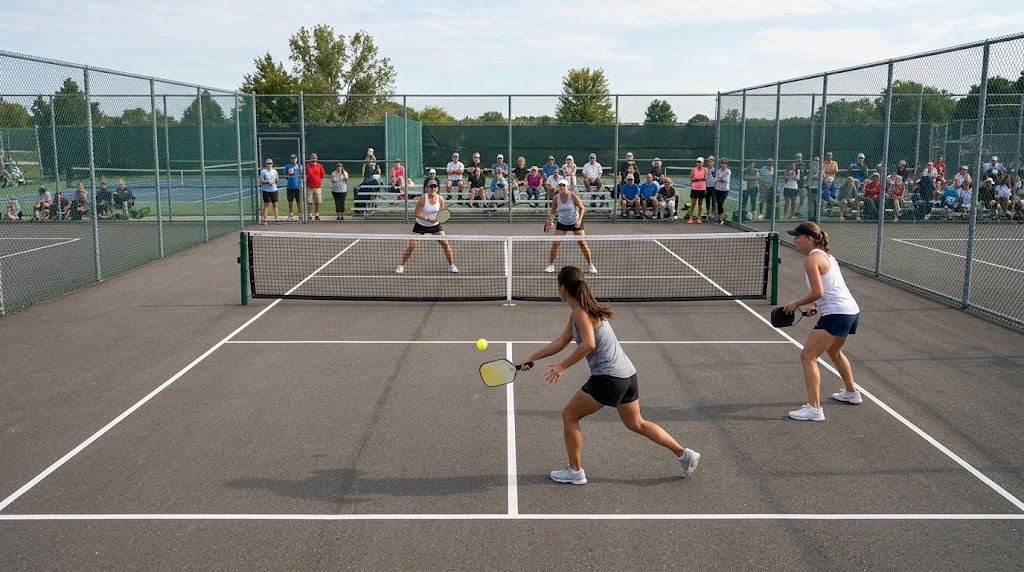


Kara Tran and Amy Li made the decisive move when it mattered, taking Women’s 4.0-4.49 Doubles 11–2 on Sept. 20, 2026.
The straight-games result carried a nine-point margin. Tran and Li needed only the recorded game to establish control, while Debbie Beliveau and Barbara Jones found their two points against a pairing that never required another game to settle the outcome.
Ratings, With the Outcome in Mind
The pre-match ratings offered a useful snapshot of the field, not a prediction or a measure of current form. Beliveau arrived at 4.386 and Jones at 4.138, giving their team the higher individual numbers on the supplied list.
Tran’s 3.543 and Li’s 3.925 told a different part of the story. The gap between the pairings’ average pre-match ratings was 0.478 points: 3.734 for Tran and Li, compared with 4.212 for Beliveau and Jones.
That context makes the result more than a simple score. The lower-rated pairing on paper turned the supplied matchup into a commanding nine-point win. The ratings remain historical context; the 11–2 result is the recorded outcome.
How the Game Added Up
Only one game was recorded, so there is no second game to compare and no basis for describing this as a comeback, a finale or a three-game battle. Tran and Li’s 11 points supplied the winning total, while Beliveau and Jones’ two points kept the scoreboard from a blank shutout.
The nine-point margin is the cleanest measure of the gap. It shows that Tran and Li built enough of a cushion to finish in the opening game, rather than merely edging ahead late. Beliveau and Jones’ contribution came within the same recorded game, leaving the result decisive without diminishing their effort.
The Kitchen Lesson Behind the Numbers
The score does not record individual rallies, dinks, faults or out-of-bounds plays, so those details cannot be assigned to any of the four competitors. What the result can support is a general lesson: doubles teams often create pressure by managing space, especially around the non-volley line.
Controlling the non-volley line means positioning effectively near the kitchen while respecting its rules. A team that establishes that area can make opponents handle tighter angles and more disciplined returns. It is a strategic advantage, not proof that a player hit any particular shot here.
Dinks can be useful when a team wants to reset a point or draw an opponent into a difficult contact. Their value depends on depth, patience and placement. A dink that sits too high can invite an attack; one that misses long can hand over a point. Those are conditional examples, not descriptions of this match.
The kitchen rule adds another layer. Players may not volley the ball while illegally inside the non-volley zone, and they must also avoid violating the zone’s boundaries during a volley action. That is different from simply standing near the line and playing a controlled shot. The supplied result does not establish that any named player committed such a violation.
Out-of-bounds risk works the same way. A team trying to sharpen an angle or drive a ball deep must balance aggression with the chance of missing the court. General pickleball analysis favors choosing the target that fits the situation, not assuming that power alone will produce the next point.
For Tran and Li, the recorded game supplied the statement: an 11–2 straight-games win built on a nine-point margin. For Beliveau and Jones, the two points were part of a competitive effort that could not overturn the result.
The takeaway is straightforward. Pre-match ratings can frame a matchup, but the court decides the story. On this date, Tran and Li turned their supplied ratings snapshot into a clean, commanding performance—and left the result speaking loudly enough without needing another game.