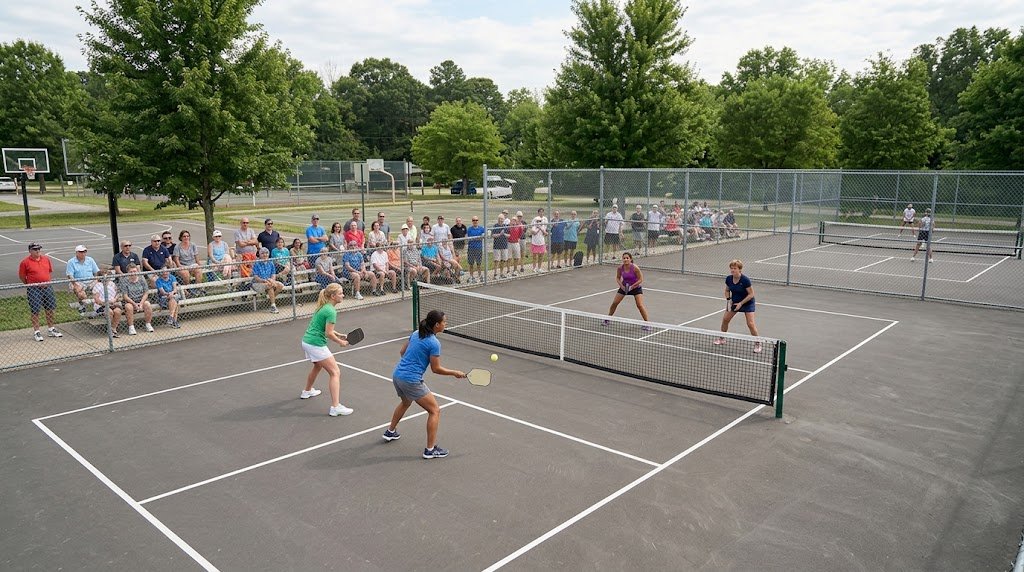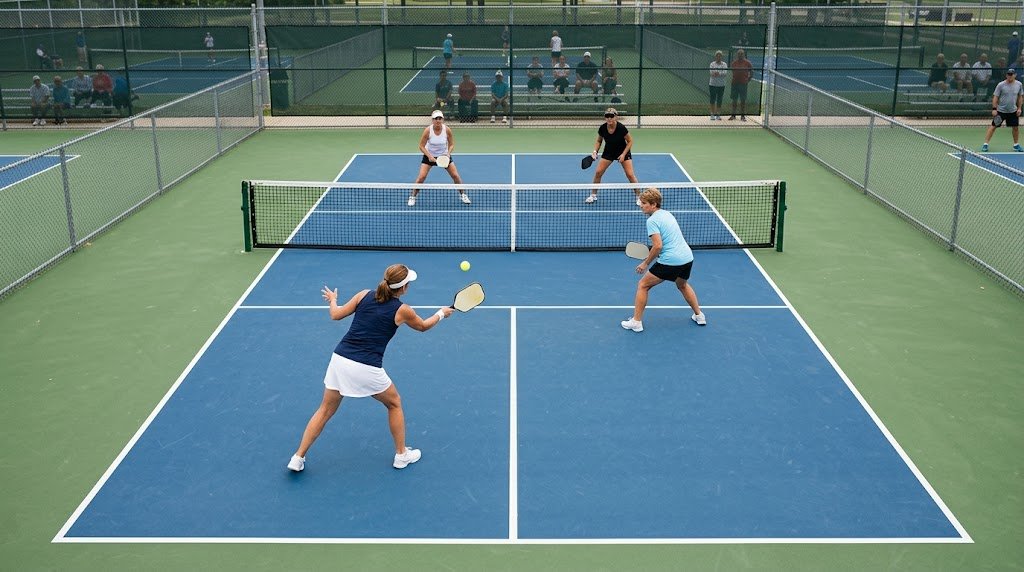

Jacqueline Homrighausen and Lisa Anne Poshard turned a Week 1 – Women’s 3.5 doubles assignment into a crisp straight-games statement, beating Jennifer Beckner and Candice Gaspari Gravelle 11–6.
The result was a five-game margin on the only recorded scoreboard: 11 points against 6. No second game appears in the source data, so this was a one-game win rather than a best-of-three sweep.
Rating Snapshot Meets Result
The pre-match ratings supplied with the match offered a mixed backdrop. Beckner arrived at 3.629 and Gaspari Gravelle at 3.293, while Homrighausen was listed at 3.389 and Poshard at 2.885.
Those figures were snapshots, not current ratings and not a prediction of future changes. They also did not guarantee the outcome. Homrighausen and Poshard combined the higher of the two team ratings with the lower, then finished on top by five.
Beckner and Gaspari Gravelle combined for 69.2% of the points that were recorded, leaving 30.8% for the winners. That split describes the scoreboard only; it does not reveal how many rallies were played or how any individual exchange unfolded.
What the Single Game Contributed
The opening—and only recorded—game supplied the entire result. Homrighausen and Poshard reached 11 first, while Beckner and Gaspari Gravelle finished at 6. There was no recorded second game in which the margin could narrow or the match could stretch.
That makes the win a clean, commanding statement rather than a nail-biter. It also places the emphasis on the pairing: Homrighausen and Poshard converted their doubles context into the result, while Beckner and Gaspari Gravelle were held to six.
No rally-by-rally record was supplied, so the article cannot identify a decisive run, a service break or a particular error. The verified takeaway is simpler and still sharp: the winning team controlled the final count by five in the game that decided the match.
Kitchen Control, Without the Kitchen Crime
General pickleball analysis helps explain why a five-game edge can feel substantial. Controlling the non-volley line—often called the kitchen line—usually means establishing a patient, balanced position before looking for an attacking opportunity. A team that gets there together can compress the court, cut off angles and make the next shot harder to place.
That is different from volleying illegally inside the kitchen. A player may not volley while standing in the non-volley zone or touching it, and the rules also cover momentum after a volley. Letting the ball bounce before hitting it is not a volley, so that sequence does not create the same violation. No specific violation was recorded for any of these four players.
Dinks are the soft-touch currency around that area. A well-placed dink can pull an opponent forward, invite a pop-up or reset a point without taking an unnecessary risk. The useful target is not maximum softness; it is a ball that lands safely and forces the other team to hit upward.
Faults and out-of-bounds risk provide the other side of the equation. A shot that misses the court, a ball that fails to clear the net and an illegal volley can all end a point quickly. Players also need to respect the two-bounce rule and avoid stepping into the kitchen at the wrong moment.
Those principles are general, not a reconstruction of this match. The source records the teams, the players, the pre-match ratings and the 11–6 outcome, but not the rallies, faults or shot selections that produced them.
For Homrighausen and Poshard, the practical lesson is that their partnership delivered the cleanest possible version of this result: one game, five-point separation and no need for a follow-up. For Beckner and Gaspari Gravelle, the scoreboard leaves a clear benchmark. Against a pairing that reached 11 first, the next opportunity begins with making the kitchen a place of pressure—not a place of free points.