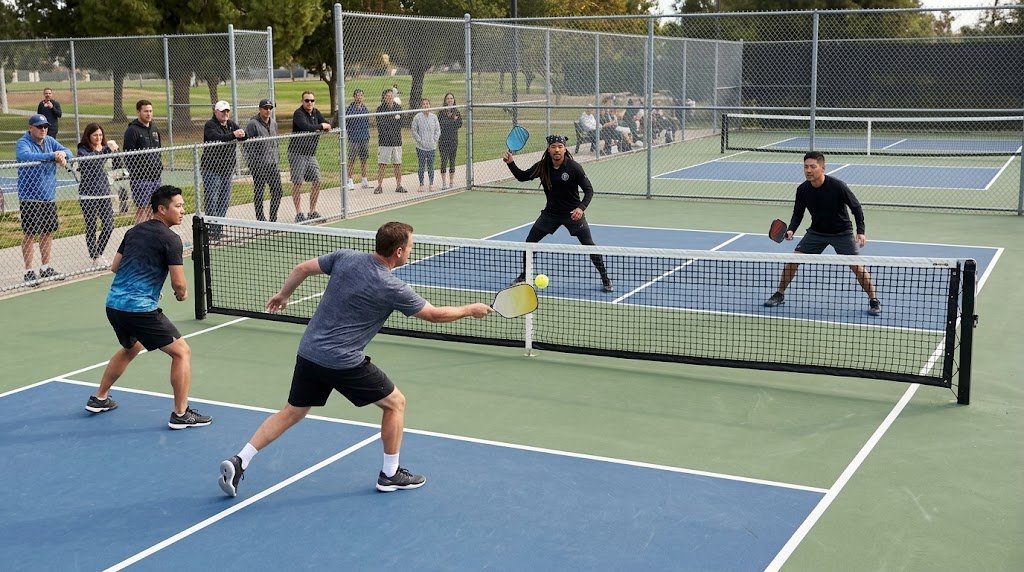


Kitlong Lai and Daryl James Bulaon left a six-point gap on the scoreboard with an 11–5 victory over Prija Phaphouampheng and Arin McGunigle on September 20, 2026. Recorded under Men's 3.5-3.99 Doubles, the confirmed DUPR result gives Lai and Bulaon a clear win in a matchup with an interesting spread of pre-match ratings.
Five points kept Phaphouampheng and McGunigle on the score sheet, but 11 settled the game. It is a decisive margin, without being a shutout. There is no need to dress it up as a last-point escape: Lai and Bulaon finished with six more points than their opponents in the one game contained in this record.
That distinction matters when reading a scoreline. An 11–5 result shows the final separation. It cannot show whether those points arrived steadily, in a burst, or after repeated changes of serve. The useful sporting story starts with what is there: a clear winning margin and four players whose historical ratings add context.
Four ratings, one doubles result
Lai carried the highest recorded pre-match doubles rating in this matchup at 3.779. Bulaon's snapshot was 3.202. On the other team, Phaphouampheng was listed at 3.062 and McGunigle at 3.538. Those numbers belong to this match's historical record; they should not be read as live ratings today.
The distribution is more interesting than a simple higher-rated-team label. Lai's number sat above both opponents, while Bulaon's fell between theirs. Doubles places those individual histories into a shared result. The record credits Lai and Bulaon with the victory together, rather than telling us which partner supplied the decisive shots.
That is part of what makes doubles compelling. A pairing is more than a pair of individual numbers, but a score does not measure communication, movement or shot selection separately. Here, the ratings provide the background and 11–5 provides the outcome. Neither needs a fictional player quote to make the matchup worth discussing.
The kitchen is where the questions get interesting
For anyone trying to improve their own doubles game, this is a useful scoreline to think about through the lens of kitchen play. How can a team earn a better position near the non-volley line? When does a dink create a problem rather than simply send another ball across the net? These are general tactical questions, not claims about how Lai and Bulaon won their points.
A controlled dink can keep an opponent from having an easy attacking ball. Placement can matter as much as pace, and patience can be productive when it leads to a more favorable next shot. The kitchen is not just a place to stand; it is a part of the court where positioning and shot choice interact.
There is also a clear difference between working close to the non-volley line and volleying illegally from the kitchen. A team can seek the advantages of forward positioning while still needing to respect that restriction. Good general advice is to value control alongside aggression, rather than treating every reachable ball as an invitation to swing harder.
Boundaries, faults and the six-point gap
Out-of-bounds risk belongs in the same conversation. A ball directed toward a sideline can ask a difficult question of an opponent, but a smaller target gives the hitter less margin. A miss or another fault ends the rally; it does not automatically tell us who earns a point without knowing the scoring situation.
This match record does not log those events, so the six-point margin cannot honestly be assigned to missed dinks, kitchen violations or balls sent long. Those details would require a richer match report. What the result does establish is that Lai and Bulaon reached 11 while Phaphouampheng and McGunigle finished at five.
For the winners, that is a solid result to add to their recorded journey. For readers, it is another reminder of why doubles scores deserve more than a glance: individual ratings supply the setup, a partnership shares the outcome, and the final margin supplies the headline. On this occasion, Lai and Bulaon had the better number.