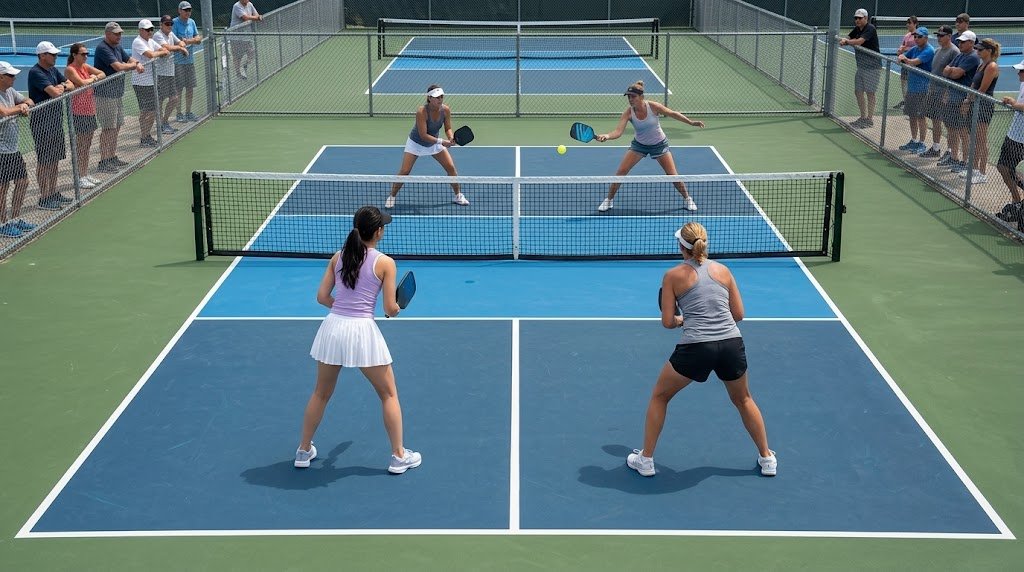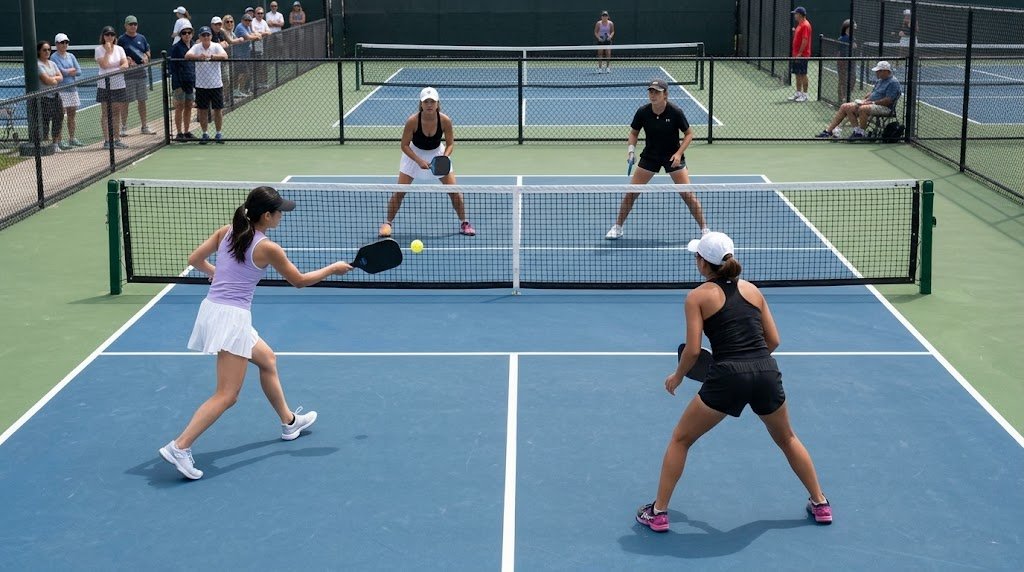


Emmaline Neville and Brooklyn Lee did not need a photo finish to make a point. The doubles partners ran up an 11–0 scoreline and closed the recorded Women’s 4.0–4.49 Doubles match in straight games, producing a commanding result defined by dominance rather than drama.
A Blank Page at the Scoreboard
The numbers tell the story without padding: Neville and Lee finished at 11, while Kara Tran and Amy Li were held at 0. That is an 11-run scoring margin and a complete shutout on the recorded scoreboard. It is not evidence of 11 rallies won, and the source does not supply rally-by-rally detail.
The lopsided score supports a clear reading: the result was a statement win, not a nail-biter. Tran and Li’s side may have found moments to compete, but the recorded outcome shows that any pressure did not translate into points. The margin, rather than invented suspense, supplies the drama.
A Snapshot Before the Whistle
Pre-match ratings put the two pairs on slightly different rungs of the ladder. Tran entered at 3.529, with Li at 3.901. Neville and Lee carried 3.74 and 3.668, respectively. Those figures are a snapshot of the matchup, not current ratings or a forecast that either pair will move up or down afterward.
The rating picture helps frame the result without pretending to explain every point. Tran and Li had one partner with the higher listed rating, but doubles is a shared unit: serve placement, court coverage, communication and shot selection all matter. Neville and Lee’s 11–0 performance is the relevant scoreboard evidence; the ratings simply show the starting context.
Kitchen Control Is Not Kitchen Intrusion
In general doubles pickleball, controlling the non-volley line often means arriving early enough to take volleys at an angle, finish short exchanges or force an opponent into a defensive shot. That control is valuable because it narrows the opponent’s options and lets the pair dictate the rally.
There is an important distinction: standing at or moving beyond the non-volley line to control the kitchen is different from volleying illegally inside the kitchen. A player may volley legally when outside the kitchen, provided the other serving and positioning rules are followed. Being close to the line, moving toward it or carrying momentum into it can create risk, but proximity alone is not a kitchen violation. The recorded source does not identify any faults or specific violations.
The same caution applies to dinks, the soft shots that live near the kitchen line. A well-placed dink can pull an opponent forward, open the court or set up a put-away. But dinks can also sail long, and an otherwise patient exchange can end in an out-of-bounds error. General pickleball analysis should treat those as possible risks, not as events attributed to these named players.
Straight Games, Clean Perspective
Each game contributes to the complete result: the first 11–0 game established the dominant opening, and the second preserved the straight-games finish. Together, they produced one clean 11–0 scoreline, not two separate claims about rallies or match flow.
For Tran and Li, the result leaves a straightforward takeaway: converting chances into points, managing out-of-bounds risk and turning dinks into controlled entries will be the work to prioritize. For Neville and Lee, the victory offers a confident platform. They did not merely edge past an opponent; they turned the scoreboard into a declaration and carried it through both games.