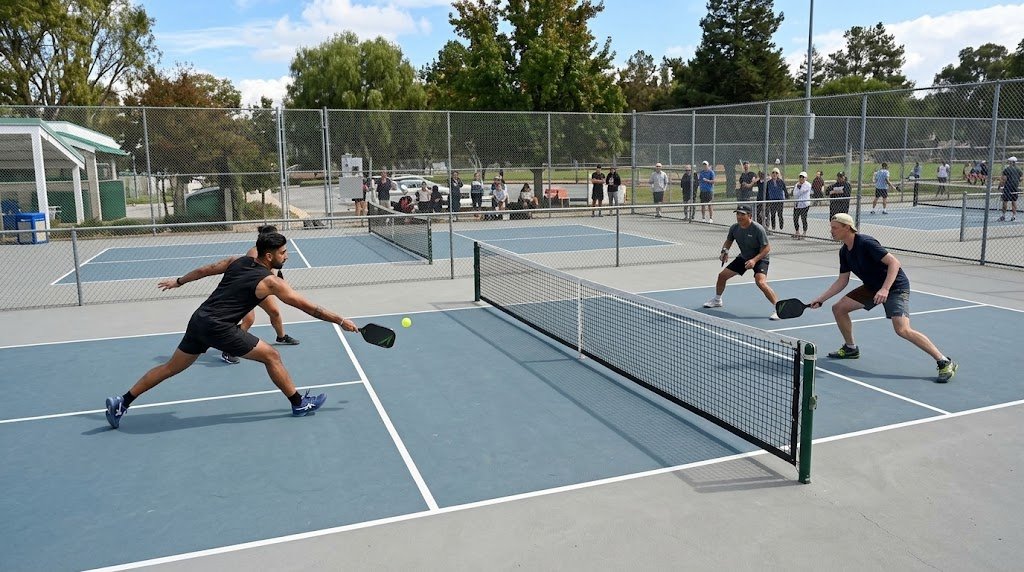


Cade Pierson and Yaamunan Venkatesan delivered the kind of 11-6 win that settles a matchup before anyone needs to invent drama.
The winning pair, Cade Pierson and Yaamunan Venkatesan, earned a straight-game victory over Katy Bickham and Dawoud Ghafarshad, 11-6, in the Mixed Doubles 4.5+ event at the $30,000 Proton National Tour by MPO - Cash Prize Tournament in Corona.
It was a commanding result, not a last-point thriller. Pierson and Venkatesan finished five points clear after one game, and this record does not supply another game to compare.
A Clean Line on the Board
The scoring margin tells the story: 11-6. Pierson and Venkatesan won by five, while Bickham and Ghafarshad held six points in the recorded game.
The pre-match ratings add useful texture without turning this into a forecast. Pierson entered at 4.986 and Venkatesan at 5.314; Bickham carried 5.229, and Ghafarshad 4.729. Those numbers are a snapshot of the matchup before play, not current ratings or a prediction of where anyone stands later.
Mixed doubles also matters here. Each pairing had to cover the court as a unit, and the 11-6 result gives Pierson and Venkatesan the cleanest read on how their team shape translated into the recorded score.
The Kitchen Lesson
For players studying the result, the most useful takeaway is positional discipline around the non-volley line.
Controlling the kitchen means managing where you stand relative to the non-volley line. A player can hold position near that line, step forward after the ball passes the line, and then play a legal volley. The kitchen itself is the area bounded by the non-volley line and the net. A player may not volley while standing inside that area or while the momentum from a volley carries them in.
That distinction matters. Owning the non-volley line is a positioning goal; volleying illegally inside the kitchen is a fault. The recorded result does not supply rally-by-rally detail, so it does not establish that either pair faulted, controlled the line on every point, or used any particular tactic.
The same caution applies to dinks. A soft, controlled exchange can pull an opponent forward and create an opening, but a dink is not automatically a winner. Miss the intended zone, send the ball long, or let the ball skip twice and the point is gone.
Out-of-bounds risk is equally important. A ball that lands beyond the sideline or baseline is out; a ball that lands on the correct boundary line is in. Keeping dinks and drives inside the court is often more valuable than simply striking harder.
Five Points of Separation
The 11-6 score suggests Pierson and Venkatesan converted their strongest moments more effectively than their opponents did. That is analysis of the margin, not a claim about unseen rallies or specific plays.
Bickham and Ghafarshad were not erased by the result. Six points still represent a competitive effort, and the margin leaves room to see a close contest within a lopsided score. What stands out is that Pierson and Venkatesan closed the game with a five-point cushion rather than a photo finish.
In pickleball, a five-point win can be a statement: steady court position, smart placement, and fewer wasted chances tend to stack up quickly. Pierson and Venkatesan’s 11-6 result is a crisp reminder that the best wins do not need a dramatic finish to leave a mark.