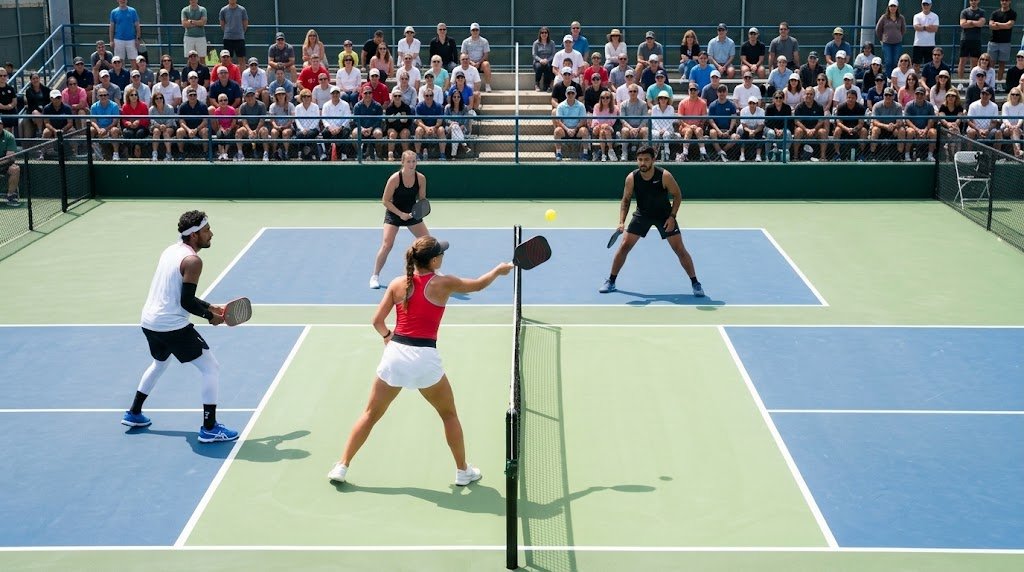
Katy Bickham and Dawoud Ghafarshad turned up the heat on Saturday, securing an 11-8 victory over Connie Yoo and Tyrone Wang in the $30,000 Proton National Tour by MPO in Corona. The mixed doubles 4.5+ clash unfolded with purposeful precision from the winners, who translated their pre-match ratings—Bickham at 5.323 and Ghafarshad at 4.75—into a steady, unrelenting performance. Wang and Yoo, rated 4.52 and 4.434 respectively, pushed hard but couldn’t disrupt the rhythm that carried Bickham and Ghafarshad across the finish line.
Commanding Control at the Non-Volley Line
The victors established early dominance by owning the kitchen edge, consistently applying pressure without overstepping. Controlling the non-volley zone isn’t about rushing in—it’s about timing, patience, and forcing opponents into uncomfortable positions. Bickham and Ghafarshad used soft, well-placed dinks to shift the Yoo-Wang duo sideways, testing their lateral movement and inviting errors. Meanwhile, they avoided the pitfall of volleying illegally inside the kitchen, a fault that occurs when a player strikes the ball out of the air while any part of their body touches the non-volley zone or its line. Staying just behind that line allowed them to attack with confidence while remaining fault-free.
Strategic Patience and Shot Selection
Rather than relying on power alone, the winning pair blended aggression with finesse. Their third-shot drops landed with precision, neutralizing Wang’s strong returns and limiting Yoo’s ability to counterattack. Each reset from the baseline served a purpose: to regain neutral positioning and reset the point’s tempo. When opportunities arose, Ghafarshad stepped in with decisive volleys, while Bickham angled her placements to stretch the court. This balance kept Yoo and Wang reacting rather than dictating, slowly eroding their composure as the score climbed.
Turning Pressure into Points
Although the match lacked the back-and-forth drama of a tight contest, the 11-8 margin reflects a winner who made the most of their chances. Wang and Yoo stayed in it until the end, showing resilience by holding serve and forcing deuces on multiple occasions. But Bickham and Ghafarshad’s consistency proved decisive—they minimized unforced errors, capitalized on loose returns, and converted key points when the pressure mounted. Every game contributed to the narrative: early breaks built confidence, middle-game holds preserved momentum, and the final stretch closed out the win with authority.
Lessons from the Kitchen
This match offers a reminder that pickleball isn’t won at the baseline—it’s won at the net. Controlling the non-volley line means dictating the pace, cutting off angles, and making opponents hit up on the ball. It’s not about aggression for aggression’s sake; it’s about intelligent positioning and recognizing when to dink, when to drive, and when to let the ball bounce. Faults often creep in when players lunge too early or fail to reset their feet—avoiding those mistakes requires discipline as much as skill. For Yoo and Wang, the takeaway is clear: sharpen the soft game, trust the process, and keep refining that kitchen touch.
Bickham and Ghafarshad didn’t need fireworks to make a statement. Their win was a testament to preparation, partnership, and pickleball IQ—a straight-games triumph that earns respect and sets a tone for what’s ahead. In a sport where margins are measured in inches and instincts, they proved that the smartest team doesn’t just play the game—they shape it.