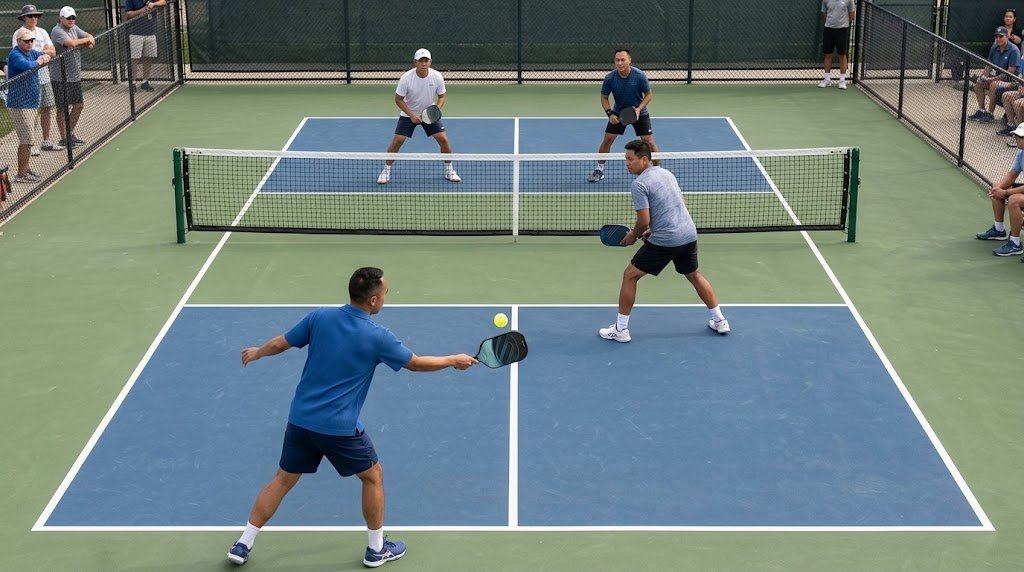


Eddie Tran and Joseph Bornilla opened the Men's 3.5-3.99 Doubles bracket with a crisp 11–6 victory over Mark Garcia and Andrew Nguyen. The winning tandem never trailed, turning a modest rating gap on paper into a decisive margin on the court. Tran entered at 3.395 and Bornilla at 2.746, while their opponents carried slightly higher pre-match marks of 3.427 and 3.625 respectively. The result flips the script on the numbers and announces the victors as a team to watch.
First to the Line, First to the Lead
The opening exchanges settled quickly into a rhythm that favored Tran and Bornilla. They established control at the non-volley zone early, using patient dinks to neutralize the opposition's power and forcing errors from the backcourt. In doubles, the team that plants itself at the kitchen line first often dictates the tempo, and that principle played out in full. By keeping the ball low and unattackable, the winners compressed the court and limited Garcia and Nguyen's chances to swing freely. The scoreboard reflected that dominance as the lead stretched beyond reach.
Rating Reality Check
Pre-match ratings are a snapshot of recent form, not a guarantee of outcome. Garcia's 3.427 and Nguyen's 3.625 suggested a slight edge on paper, but ratings cannot measure chemistry, court awareness or the day's rhythm. Tran and Bornilla played with the cohesion of a veteran pairing, covering the middle, communicating on lobs and converting transition opportunities. The five-point margin speaks to execution trumping projection. When two units are separated by fractions of a point in the algorithm, the match often hinges on who handles the kitchen chess match better.
Kitchen Geometry and Risk Management
Controlling the non-volley line is the sport's strategic high ground. A team that holds that position can volley downward, erase angles and force the opposition into defensive pops. But the kitchen demands discipline. Volleying while any part of the foot touches the zone is a fault, and even a toe on the line during a volley costs the rally. Smart teams practice a split-step just behind the line, ready to punch a high ball but disciplined enough to let a low one bounce. Dinking cross-court stretches the defense and opens the middle for a put-away, yet every dink carries out-of-bounds risk if the angle sharpens too much. The best pairs balance aggression with margin, knowing a single unforced error can swing momentum in a game to 11.
Straight-Game Signal
An 11–6 finish in a single game to 11 is a statement win. It denies the opponent any extended run, limits their data on your tendencies and preserves energy for the next round. Tran and Bornilla move forward with momentum and a clear identity: control the net, trust the soft game, strike when the window opens. Garcia and Nguyen will regroup; at this level, a six-point loss is data, not destiny. The bracket tightens from here, and the team that just dictated terms at the kitchen line has drawn the first line in the sand.