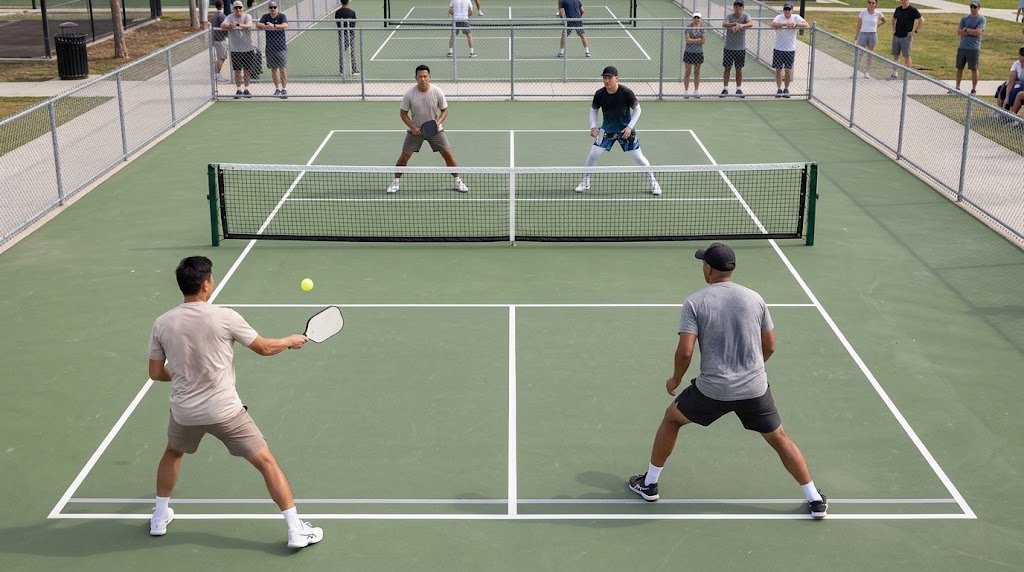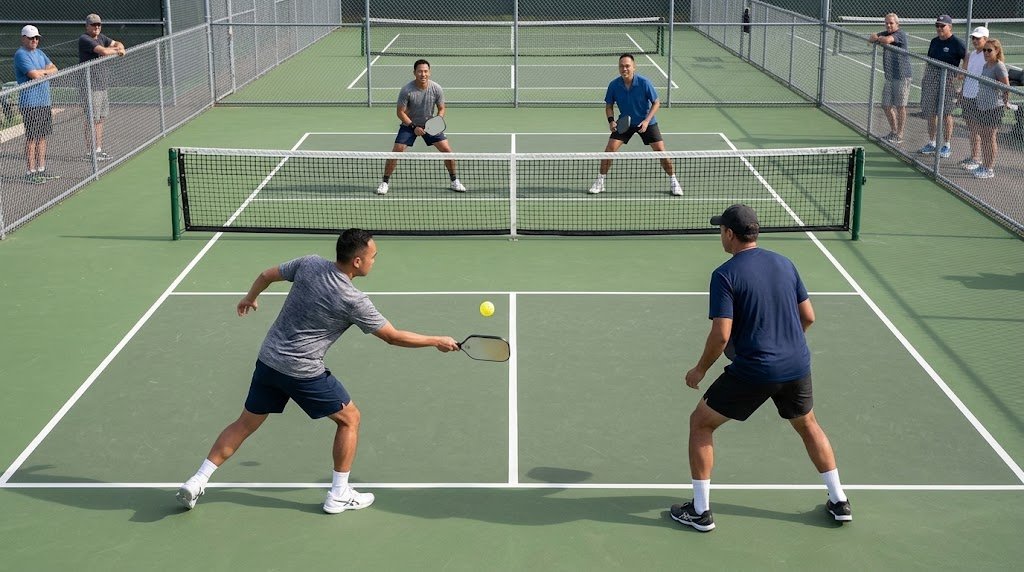

Joshua Gonzales and Benjamin Vu clinched a razor-thin 11–10 victory over Eddie Tran and Joseph Bornilla on Saturday, turning a single-point margin into a statement win in Men’s 3.5–3.99 Doubles action. The match, played as a single game to 11, hinged on the slimmest of edges—one rally, one decision, one moment of composure under pressure. Gonzales entered with a 3.515 pre-match rating, Vu at 3.263, while Tran carried a 3.361 and Bornilla a 2.679. On paper, the slight rating advantage belonged to the winners, but the scoreboard refused to reflect any gap until the final point.
A One-Game War
There was no best-of-three cushion, no second chance to regroup. The format demanded immediate precision, and both pairs delivered a back-and-forth contest that never allowed either side to breathe. An 11–10 result in a single game is the pickleball equivalent of a walk-off home run: the tension builds with every exchange, and the margin for error evaporates. Gonzales and Vu seized the decisive moment, converting their narrow pre-match rating edge into a tangible result when it mattered most.
Rating Context and the Fine Line
Pre-match ratings are snapshots, not predictions. Gonzales’ 3.515 and Vu’s 3.263 suggested a modest skill advantage over Tran’s 3.361 and Bornilla’s 2.679, yet the 0.254 average rating difference translated to exactly one point on the scoreboard. That symmetry underscores how tightly matched these teams were in this specific encounter. The numbers framed a storyline; the play wrote the ending.
Kitchen Chess: Controlling the Line Without Crossing It
In doubles, the non-volley zone—the kitchen—governs the rhythm of every point. Teams that establish position just behind the line dictate pace, forcing opponents into defensive dinks or risky drives. Controlling that real estate means planting feet a few inches back, ready to volley legally, then resetting with soft hands when the ball drops low. The danger lies in momentum carrying a player forward into the zone before the ball bounces; a volley struck while any part of the body touches the kitchen is a fault, no matter how clean the contact. Smart pairs practice the shuffle-step: advance to the line, pause, volley, then retreat or hold. That discipline turns the kitchen from a trap into a launchpad.
Dinks, Drives and the Out-of-Bounds Gamble
A well-placed dink lands shallow, kisses the net cord, and dies before the opponent can attack. Push it too deep and it becomes a setup for a put-away; push it too wide and the sideline swallows the point. Drives flatten the trajectory, testing reflexes and court coverage, but they flirt with the baseline and sidelines. Every aggressive shot carries an out-of-bounds risk that rises with fatigue and frustration. The winning formula balances patience—waiting for a genuine opening—with the courage to accelerate when the window appears. In a one-point game, a single unforced error on a drive or a misjudged dink can flip the result.
The Final Exchange
When the score reached 10–10, the next rally became the match. Gonzales and Vu executed the fundamentals under maximum pressure: held the line, forced a difficult return, and closed the door. Tran and Bornilla matched them shot for shot until that last sequence, proving the rating gap was theoretical, not practical. The 11–10 scoreline will sit in the record as a straight-game win, but anyone who tracked the points knows it was a duel decided by the thinnest possible margin—one point, one possession, one moment of clarity.