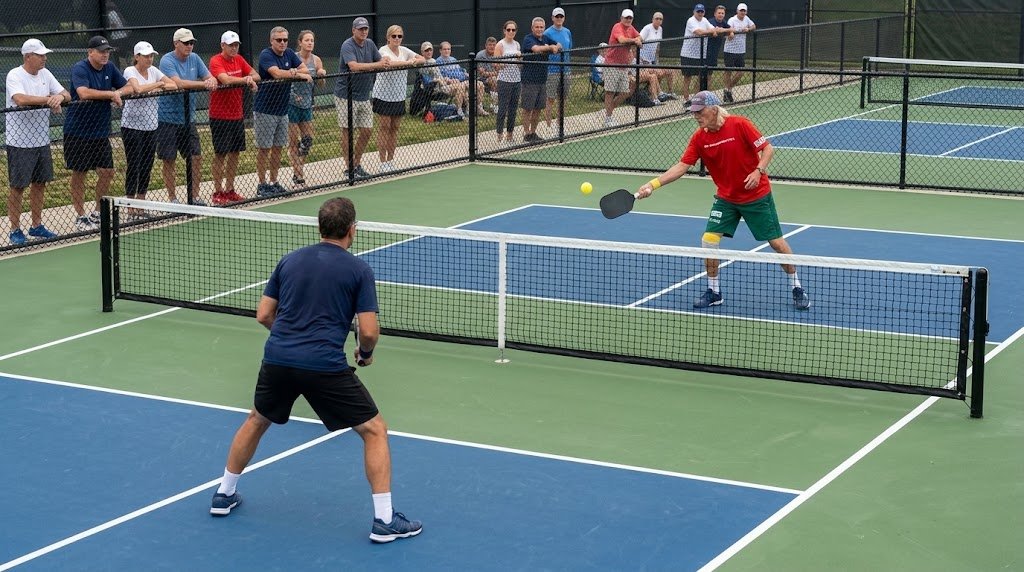
A Rating Gap Delivered on the Scoreboard
The numbers lined up before the first serve, and the match confirmed them. Brock Beamish, carrying a pre-match rating of 3.876, faced Brandon Freed, listed at 3.599, in the Open Men's Singles draw of the WPA Long Beach Open. When the recorded game ended at 11-8, the result belonged to the higher-rated competitor by a clear and decisive margin.
In singles, that margin carries weight. There is no partner to absorb a stretch of pressure or cover a slow start. The player who controls rhythm and point selection owns the court, and Beamish held that control across the full game. The WPA Long Beach Open supplied the stage, and the headline result was straightforward: straight games, one recorded contest, one clear winner.
Points Built the Lead, Not Drama
The scoring line did not whisper. An 11-8 outcome is a statement, not a coin flip. Beamish moved ahead early enough that Freed spent the opening stretch reacting rather than dictating. By the time the finish arrived, the gap had hardened into a steady lead, with 11-8 offering a three-point cushion that singles players know matters.
This was not a coin-flip contest, but it was not a runaway either. The 11-8 line leaves room to read intent: one competitor built a buffer and protected it, while the other kept the door open without ever turning it into a comeback. Each point added to a growing advantage rather than resetting the narrative.
Kitchen Positioning and Risk: A General View
Singles strategy often turns on the non-volley line, commonly called the kitchen. Standing near that line gives a player leverage for soft shots and quick reactions, but the rules create a careful boundary. The kitchen itself is not banned territory; the restriction involves volleying the ball before it bounces while inside that area. A player can occupy the kitchen, play a ball that has bounced, and stay legally active, provided the volley does not happen on the fly from within it.
That distinction separates smart control from a fault. Commanding the non-volley line pressures opponents, while entering the kitchen to hit a volley before the bounce breaks the rule. In a tightly judged match, out-of-bounds risk adds another layer, since singles players must judge lines honestly and every errant shot simply hands initiative to the other side. Analysis like this remains general; the recorded match does not document specific faults, shots, or rally sequences.
What This Result Means After the Bell
Beamish entered the WPA Long Beach Open with the stronger pre-match rating and left with the stronger record. The 11-8 result confirmed the rating snapshot rather than leaving it as a promise. For Freed, the match showed a competitive floor against a top-side opponent, while the headline score preserved Beamish's authority in a field that takes every result seriously.
Pre-match ratings are a captured moment, not a forecast or a live standings marker. Still, when a higher-rated singles player wins with that margin, the form speaks clearly. The WPA Long Beach Open continues to hand out results that matter, and this one delivered a confident answer straight through the recorded game.